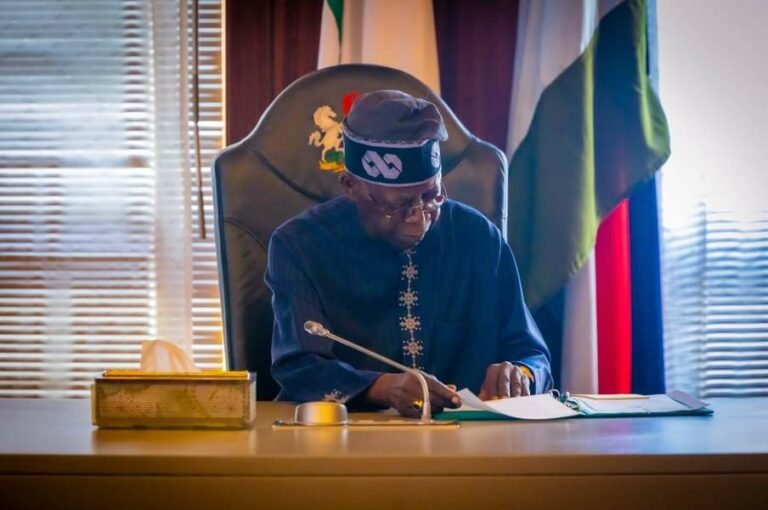
 President Bola Ahmed Tinubu
Nigeria has proposed a N47trillion Budget for 2025, despite struggling to fund its 2024 Budget of N27trillion.
The Budget for 2025 announced is what the President Bola Tinubu-led Government plans to spend and does not include expenditures by State Government, as Nigeria operates a Federal system of Government that comprises Federal, State and Local Governments.
Each entity of Government ideally draws up their budget.
According to details from the Federal Government, it pegged the crude oil benchmark at $75 per barrel, while oil production is expected to be at 2.06 million barrels per day (bpd).
In the first Budget prepared by the Tinubu-led administration, oil revenue accounted for a bulk of projected income, if precedents were to go by, it would mean that the country may expect bulk of revenue from oil in 2025.
In 2024, oil revenue budget stood at N7.94trillion while non-oil was pegged N3.52trillion, independent and other sources of revenue projection stood at N6.86 trillion.
This would mean that in 2024, 43.3% of the Federal Government revenue put at N18.32 trillion was expected from crude oil.
Already crude oil is a major export of the country.
The Government also pegged exchange rate was pegged at N1400 per dollar, noting that the Government is targeting a gross domestic product (GDP) growth rate of 6.4 percent.
This Budget is the highest in the history of the country.
The current fiscal year budget was proposed at N27.5 trillion, in 2023 it stood at N20.5 trillion, 2022 stood at N17.12 trillion, 2021 N13.5 trillion, 2020 N10.8 trillion, 2019 N8.83 trillion and 2018 N9.12 trillion.
The new figure of N47 trillion proposed however comes as the government struggles to fund its current 2024 budget of N27 trillion.
Economic report released by the CBN shows that the Federal Government earned N2.3trillion as of second quarter of 2024, it however spent N6trillion in the same period.
Of the N6trillion spent, N4 trillion went to debt servicing.
These show that the country has been unable to fund its own budget even with a N27trillion estimate.
A review of data from Debt Management Office (DMO) shows that between June 2023 and June 2024, the country’s debt profile grew by N46.9trillion.
Between March and June 2024 alone, the debt portfolio of the country increased by N13trillion.
Nigeria borrows money largely due to what has been described as “poor revenue collection”.
While the Government pegs the 2025 exchange rate at N1400, currently Dollar to Naira exchanges at over N1700, a development that has not still reduced reliance on loans for the 2024 fiscal year by the Government.
In 2024, the country pegged crude oil price at $78 while it peg that of 2023 $75.
The projection shows that the country does not plan to drastically drop exchange rate, given that it has pegged the rate at N N1400 to $1, an increase from the N750 to $1, it pegged it in 2023.
The country may also be targeting its earnings from crude oil to boost revenue, given that it targets 2.06 million barrels per day for crude oil, an increase from the 1.78 million in the 2024 budget projections.
Although in preparations to the budget presentation, the country announced that its oil production reached 1.8 million barrels per day, data from the OPEC and that published by the Nigeria Upstream Regulatory Commission (NUPRC) disputes this.
As of September, the country recorded 1.3 million crude oil production per day (1.5 million if blended condensate and unblended condensate are added).
The highest production was in January 2024, when 1.4 million barrels were recorded (1.6 million if blended condensate and unblended condensate) were added.
The data shows that the country was unable to meet its 1.78 million target for 2024, despite its new claim of producing 1.8 million barrels per day.
While the country may be banking on its devaluation of Naira as part of strategy for increased revenue, the country is historically poor in terms of revenue in tandem with budgeted estimates.
It remains unclear how the country plans to meet its target of N47trillion, which is about the total Budget for 2023, 2022 and 2021 and about twice its 2024 Budget estimates.