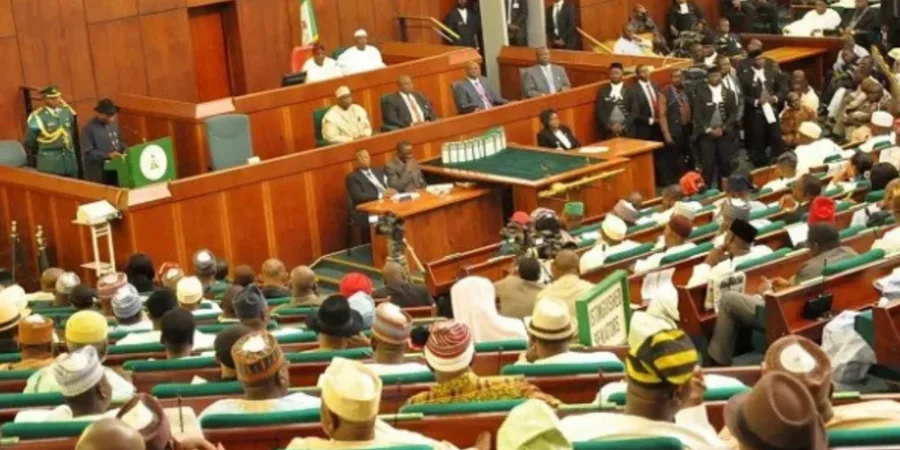
The House of Representatives will on Thursday vote on a Constitutional Amendment Bill seeking to establish State Police across Nigeria, a move widely seen as a major step toward decentralizing the country’s security architecture amid worsening insecurity.
The Deputy Speaker of the House of Representatives and Chairman of the House Committee on Constitution Review, Benjamin Kalu, disclosed this while speaking with journalists in Abuja on Wednesday.
Kalu urged all Lawmakers to attend Thursday’s Plenary Session and participate in the vote on the proposed constitutional amendment.
The planned vote comes days after the Presidency revealed that constitutional amendments required for the establishment of state police were nearing completion.
Speaking after a high-level consultative meeting on State Police at the Presidential Villa in Abuja last week, President Bola Tinubu’s Chief of Staff, Femi Gbajabiamila, said discussions on the initiative had gained significant momentum following months of deliberations.
“We started deliberations in the last three or four months on how to go about the establishment of State Police as directed by Mr. President,” Gbajabiamila had said.
“Establishing State Police is not something that you do with the snap of the fingers. There is a lot involved in terms of constitution and legalities, and thank God we have now gained a lot of traction.”
He added, “Hopefully, the amendment will come shortly, and the details of the amendment will come after that.”
According to him, the current focus is on amending relevant sections of the Constitution, while enabling legislation would be pursued afterward.
“Right now, what we are looking at is the constitutional amendment itself, and then the enabling law would follow thereafter. That is what we have been deliberating on in the last couple of hours,” he stated.
The renewed push for State Police comes amid persistent security challenges across Nigeria, including terrorism, banditry, mass kidnappings, attacks on rural communities and other violent crimes that have continued to overwhelm the Country’s centralized policing system.
Critics of the existing structure have repeatedly argued that the Nigeria Police Force (NPF) is overstretched, underfunded and unable to respond effectively to local security threats because operational control remains concentrated at the Federal level.
Several States have established regional security outfits, including Amotekun in the South-West and similar security networks in other regions. However, the groups lack full constitutional backing and do not possess the powers of conventional Police agencies.
Gbajabiamila had added that President Tinubu would receive a comprehensive report on the outcome of the consultations.
The meeting was attended by Senior Government officials, including Deputy Senate President Barau Jibrin, Deputy Speaker Benjamin Kalu, Inspector-General of Police Tunji Disu, Attorney-General of the Federation and Minister of Justice Lateef Fagbemi (SAN), among others.
The Nigerian Government has maintained that State Police would strengthen grassroots security, improve intelligence gathering and enhance the capacity of State Governments to tackle emerging security threats and protect lives and property.