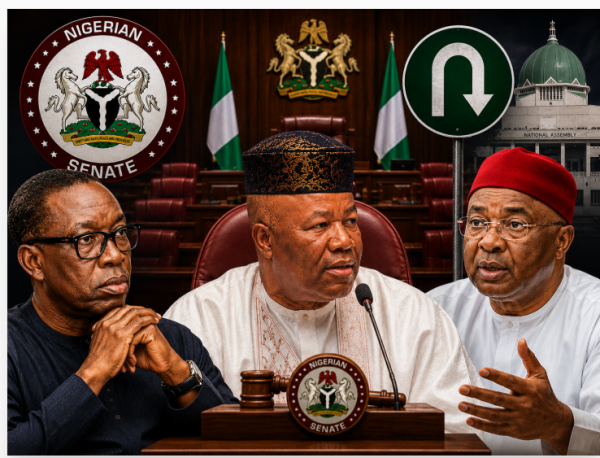
In what many insiders are already interpreting as a major political backtrack capable of reshaping the leadership contest in the 11th Senate, the Nigerian Senate has reversed the controversial amendment to its Standing Orders that had effectively shielded Senate President Godswill Akpabio from possible challenges by returning former Senators.
MJConcept TV News reports that the reversal has now reopened the pathway for powerful political figures such as former Delta State Governor, Senator Ifeanyi Okowa, and outgoing Imo State Governor, Senator Hope Uzodimma, to potentially contest for the office of Senate President should they return to the Red Chamber in 2027.
The controversial amendment to the Standing Orders presided over by Senator Akpabio, had earlier restricted eligibility for principal offices, including the office of Senate President, to ranking Senators who had served at least two terms, with one of those terms being the immediate term preceding nomination.
Political observers had widely interpreted the amendment as a strategic move aimed at blocking influential former Senators and incoming political heavyweights from contesting against Akpabio for the Senate Presidency.
However, in a dramatic twist, the Senate on Wednesday reversed the amendment following a motion sponsored by Senate Leader Opeyemi Bamidele and adopted under the supervision of Deputy Senate President Jubril Barau.
The reversal effectively restores eligibility to former Senators who had previously served in the National Assembly but were excluded by the amended rules.
MJConcept TV News gathered that among those believed to have been politically affected by the earlier amendment were Senator Ifeanyi Okowa, who represented Delta North Senatorial District between 2011 and 2015, and Senator Hope Uzodimma, who served as Senator for Imo West between 2015 and 2019 before becoming Governor.
Okowa is still remembered within legislative circles for his role in championing the National Health Bill during his time in the Senate, while Uzodimma retains extensive political networks within the APC and among Governors.
There has also been growing speculation around Senator Adams Oshiomhole, the outspoken former Governor of Edo State who is currently serving in the Senate, although some political insiders allege that Oshiomhole and Uzodimma may ultimately align forces in any future leadership battle within the Senate.
The decision to reverse the amendment to the Senate standing orders came amid growing tension within the Chamber following a public disagreement between Akpabio and Oshiomhole over the interpretation of the Senate Standing Rules.
The clash erupted after Akpabio commenced reading the Votes and Proceedings of Tuesday’s sitting when Oshiomhole raised a point of order.
Akpabio, however, ruled him out of order, citing provisions in the 2023 Standing Rules that prohibit Senators from raising points of order during that stage of proceedings.
The incident reportedly exposed deeper frustrations among some Senators over the controversial amendment and may have accelerated the decision to reverse it.
Political analysts say the reversal could significantly alter the internal power calculations ahead of the next Senate leadership contest, especially if high-profile former Governors and ex-Senators return to the National Assembly in 2027.
For now, the reversal has fueled fresh speculation that Akpabio may no longer enjoy the kind of institutional protection many believed had been erected around his leadership position.