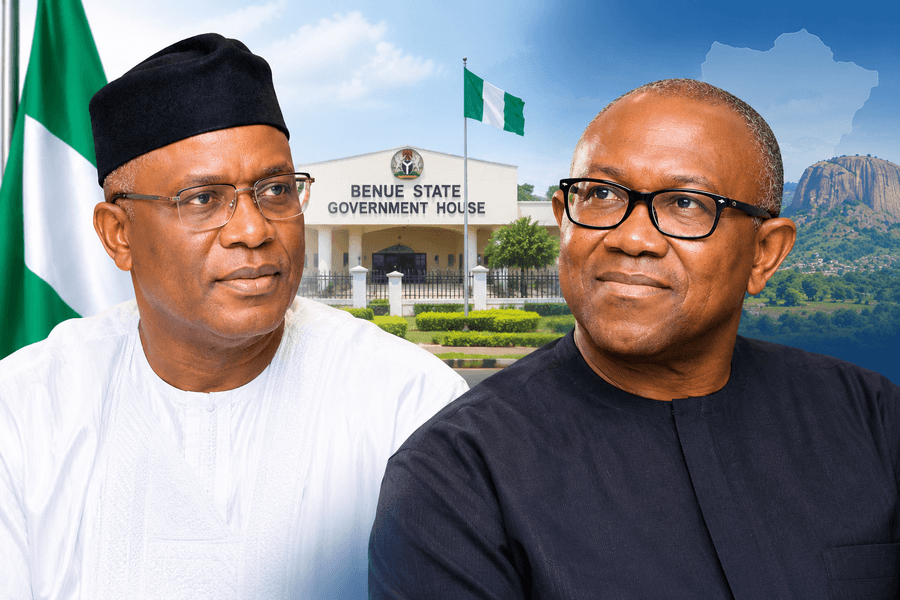
Benue State Governor, Rev. Fr. Hyacinth Alia, has pushed back strongly against allegations that persons linked to his administration were behind Tuesday’s attack on the convoy of Nigeria Democratic Congress presidential candidate, Peter Obi, describing the former Anambra State governor as a politician with a history of stirring controversy around the state.
The rebuttal came as Obi explained that his visit to Benue had nothing to do with his 2027 presidential campaign, but was intended to enable him commiserate with victims of the 2025 Yelewata massacre.
Obi’s visit descended into controversy after his media aide, Esther Umoh, posted videos showing a road blocked near the Air Force Base along Boko Road as his convoy attempted to proceed into the state.
“We have just arrived in Benue State, where alleged sponsored thugs have blocked Boko Road by the Air Force Base, attempting to prevent Peter Obi from gaining access into the state,” Umoh wrote on X.
Another video showed some individuals running after vehicles in the convoy, with Umoh alleging that they were attempting to attack members of Obi’s entourage.
However, the identities of those in the videos and the circumstances that led to the confrontation could not be independently established.
Alia Camp Fires Back
Reacting, Alia’s Chief Press Secretary, Tersoo Kula, dismissed suggestions that the state government had anything to do with the incident.
Kula described Obi’s allegation as an attempt to drag the governor and his administration into what could have been an internal political dispute within the NDC.
The governor’s spokesman went further to question whether Obi actually visited Makurdi, accusing him of having antecedents of making claims about Benue that the government considered untrue.
According to him, Obi posed no political threat to Alia and, even if he did, the governor would rely on established security agencies rather than thugs.
Kula portrayed Alia, a Catholic priest, as a peace-loving leader whose government neither patronises nor deploys thugs for political or security purposes.
He also questioned why the relevant security authorities were allegedly not formally notified about Obi’s movement, arguing that a visit by a presidential candidate would ordinarily involve coordination with the Commissioner of Police and other security agencies.
“The Alia administration will not be distracted by attempts to manufacture political controversies where none exists,” Kula said.
He advised Obi to resolve whatever disagreements he might have within the NDC instead of blaming the Benue government, insisting that the state remained open to political actors and other Nigerians who came in peace.
Obi: I Came To Mourn, Not Campaign
Obi, however, offered a different account, insisting that there was nothing political about his mission to Benue.
“I am in Benue today not for campaigns. I only wanted to go to a place where people lost their lives, to condole and show solidarity with them,” he said.
The NDC candidate expressed disappointment over the incident, saying it reflected what he considered the deteriorating quality of Nigerian politics.
“You can see the level to which our politics has degenerated,” Obi said.
He linked the incident to an appeal he made a day earlier at the formal opening of the Allied Peoples Movement presidential campaign office in Abuja, where he urged politicians to embrace what he called a “politics of unity.”
“That was why yesterday, while joining the APM candidate in launching his office, I used the opportunity to plead with our people, let our next politics be a politics of unity,” Obi said.
His explanation effectively presented the Benue trip as a humanitarian visit rather than a campaign stop, while the Alia administration maintained that it knew nothing about those who allegedly confronted his convoy.
The competing accounts have now shifted attention to the security agencies to establish who blocked the road, why they did so and whether the confrontation was spontaneous or politically organized.