Nigerians continue to grapple with unreliable electricity supply, worsened by a failing national grid and the collapse of mini-grids meant to serve remote communities.
Despite repeated Government promises to strengthen the national grid, recent budget allocations have triggered widespread public outrage.
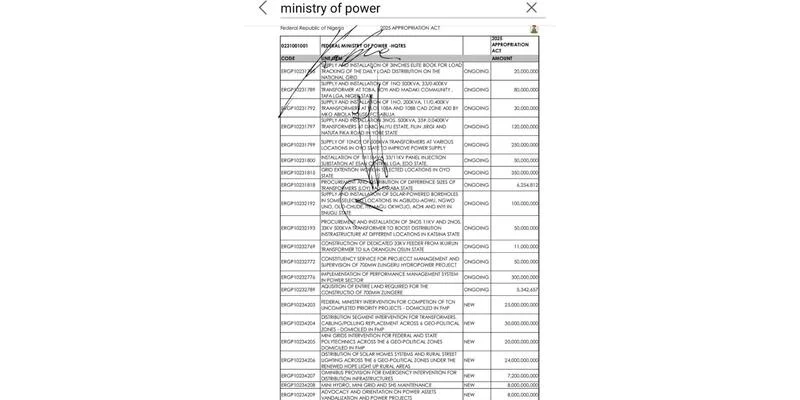
In the 2025 Budget, President Bola Tinubu’s administration earmarked N10 billion for the solarization of the Presidential Villa—a move that would disconnect the seat of power from the national grid, even as millions across the country remain in darkness.
A Budget review reveals that while N10 billion is devoted to powering the Villa with solar energy, each of Nigeria’s six geopolitical zones has been allocated only N5 billion for transformers, cables, and polling infrastructure—equipment entirely dependent on the fragile national grid.
That translates to just N833 million per state for electricity distribution infrastructure in 2025, compared to the lump sum for a single location—the Villa. In stark contrast, the national grid suffered its second collapse in 2025, plunging cities like Lagos and others into prolonged blackouts, as previously reported by MJConcept TV News.
Critics have described the solar project as excessive and insensitive, given that many Nigerians still lack basic access to electricity.
The World Bank estimates that only 32.9% of rural residents have access to power, while over 85 million Nigerians—more than 4 in 10 people—are completely disconnected from the grid.
Minister of Power, Bayo Adelabu, admitted that 80 million Nigerians currently live without electricity.
While solar energy has been promoted as an alternative, affordability remains a major barrier. Field investigations by MJConcept TV News reveal that a basic 26-amp solar system, capable of powering just a fan, TV, and light bulbs, costs between N240,000 and N280,000 to purchase and install. Even a modest seven-watt panel goes for N142,500, making it out of reach for many households.
As of now, only about 500,000 Nigerians are using solar panels in their homes, according to renewable energy platform ESI Africa.
Despite this, just N20 billion—double the Villa’s allocation—is budgeted for mini-grid solar interventions across all federal and state polytechnics in the country.
The discrepancy has fuelled accusations of misplaced priorities, with citizens questioning the Government’s commitment to equitable energy access.