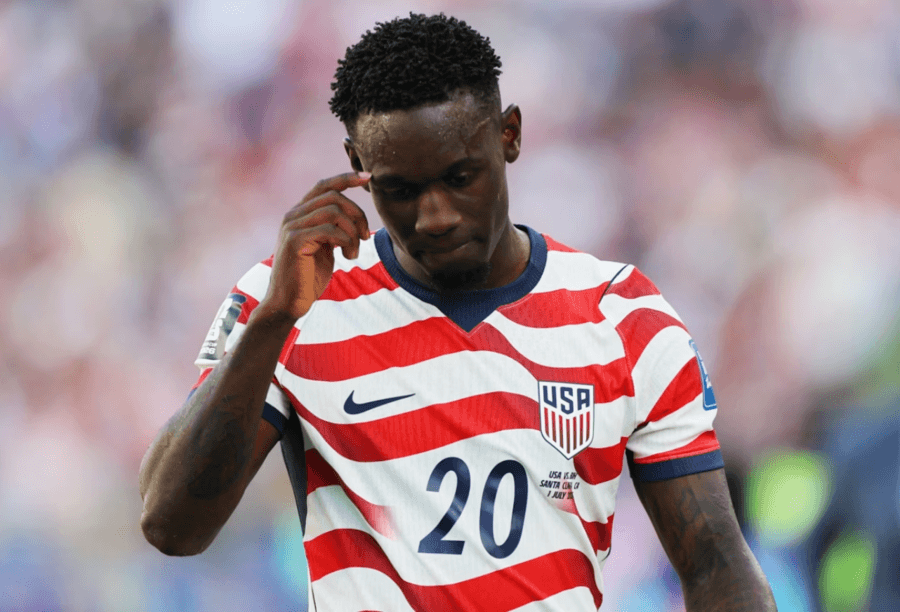
Nigerian-born United States striker Folarin Balogun experienced a bitter-sweet night at the FIFA World Cup after scoring and later receiving a red card as the USA defeated Bosnia-Herzegovina 2-0 in their Round of 32 clash at the San Francisco Bay Area Stadium.
Balogun, who was born in Brooklyn, New York, to Nigerian parents and was also eligible to represent Nigeria before committing his international future to the United States, opened the scoring for the Americans in the knockout encounter. His goal helped set the tone for a famous win as the host nation advanced to the last 16.
However, the 24-year-old’s night took a dramatic turn after he stepped on the ankle of Bosnia-Herzegovina defender Tarik Muharemovic. Following a review, the forward was shown a red card, leaving the USA to complete the match with 10 men.
The incident placed Folarin Balogun in a rare World Cup category. He has now become one of the few players to score and also be sent off in a knockout match at the tournament.
Before him, football greats such as Zinedine Zidane, Ronaldinho and Garrincha had suffered similar fates after scoring in World Cup knockout games. Zidane was sent off in the 2006 final, Ronaldinho in the 2002 quarter-final, while Garrincha was dismissed in the 1962 semi-final.
Despite Balogun’s dismissal, the USA held firm and sealed the win, with Malik Tillman adding the second goal from a free kick. The victory sent the Americans into the Round of 16, where they are expected to face Belgium.
The red card also means Balogun will miss the next match through suspension, a major blow for the USA considering his importance to Mauricio Pochettino’s attack.
Reacting after the match, Pochettino strongly defended the former Arsenal striker, insisting the challenge was accidental and not worthy of a dismissal.
“Balogun? Never intentional, never a red card,” the USA coach said.
“Watching it after on TV, it was never the intention to step onto the player; it’s a normal action in football that happens by accident.”
Folarin Balogun’s journey has continued to draw attention because of his Nigerian heritage, American birth and English upbringing. Born to Nigerian parents, raised in London and developed through Arsenal’s academy, he eventually chose to represent the United States at senior level.
For Nigerians watching from home, his latest World Cup moment carried mixed emotions: pride in another player of Nigerian blood making global headlines, and regret that his brilliance is now being enjoyed by another country.