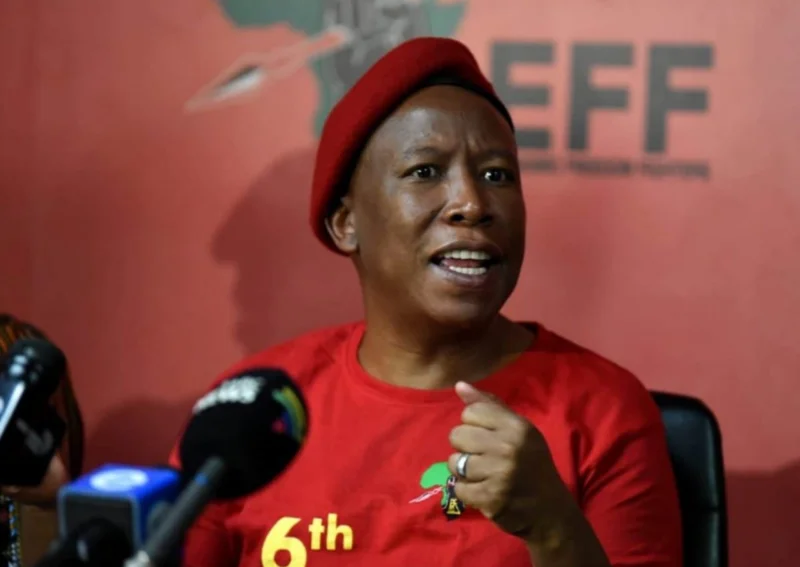
The leader of South Africa’s Economic Freedom Fighters (EFF), Julius Malema, has strongly criticized the wave of xenophobic attacks targeting foreign nationals, including Nigerians, challenging perpetrators to justify their actions with tangible economic outcomes.
Speaking amid rising tensions, Malema questioned the rationale behind violent campaigns against immigrants, particularly claims that foreign nationals are responsible for unemployment in South Africa.
“You say Zimbabweans take your job, Nigerians take your jobs and you March and close shops and beat up people, tell us after doing all this, how many jobs have you created.”
His remarks come at a time when Nigerians and other African migrants in South Africa have reported renewed harassment, intimidation, and violent attacks, with businesses looted and communities destabilized.
Malema further criticized the destruction of immigrant-owned businesses, arguing that such actions only worsen unemployment rather than solve it.
“You have beaten them, you have taken them out of the country, how many jobs have you created from it. You close a shop that hires five people and you say they take our jobs. After closing that shop, how many jobs have you created.”
The EFF leader also took aim at individuals driving the attacks, describing them as lacking the capacity to address the country’s economic challenges constructively.
“Unskilled men, with no skill, none whatsoever, the only skill they have is to drink and they want to pretend like they are revolutionaries. “
Distancing himself from populist rhetoric that promotes hostility toward other Africans, Malema emphasized that he would not seek political support based on division and hatred.
“I don’t want votes that say to me, I must hate Africans for you to vote for me.”
Malema’s comments add a political dimension to the growing crisis, which has already drawn sharp reactions from Nigerian authorities.
Earlier, the Nigerian Government, under the leadership of President Bola Ahmed Tinubu, through the Nigerians in Diaspora Commission (NIDCOM), condemned the South African Government’s handling of the attacks.
In a statement signed by its Chairman/Chief Executive Officer, Abike Dabiri-Erewa, the Commission described the situation as worsening despite prior diplomatic engagements between both countries.
“While many expected a de-escalation of tensions following earlier engagements between both Governments, the situation on the ground is deteriorating,” Dabiri-Erewa said.
She revealed that children of Nigerian descent in affected areas are increasingly afraid to attend school, while many business owners have shut down operations over fears of looting and targeted violence.
According to her, reports received by the Commission indicated fresh incidents of violence and intimidation within a 72-hour period leading up to Wednesday, with community leaders documenting multiple cases.
“We state clearly that NIDCOM rejects the profiling and generalization of all Nigerians. Crime has no nationality. Any individual, regardless of origin, who commits an offence should be investigated and made to face the full penalty of South African law.
“However, collective punishment and blanket labelling of an entire nationality are unacceptable and dangerous,” the Commission had added.
NIDCOM also called for immediate intervention by South African authorities, including increased Police presence in communities where Nigerians reside and conduct business.
The urgency of the situation was underscored by reports of fatalities. The Nigerian Consulate in Johannesburg confirmed the deaths of two Nigerians — Amaramiro Emmanuel and Ekpenyong Andrew — amid the escalating violence.
According to the News Agency of Nigeria (NAN), Consul-General Ninikanwa Okey-Uche disclosed that Emmanuel died from injuries allegedly inflicted by personnel of the South African National Defence Force after a beating on April 20.
She added that Andrew was arrested on April 19 in Pretoria’s Booysens area following an alleged confrontation with Tshwane Metro Police officers. His body was later discovered at the Pretoria Central Mortuary, intensifying concerns over the treatment and safety of Nigerians in South Africa.