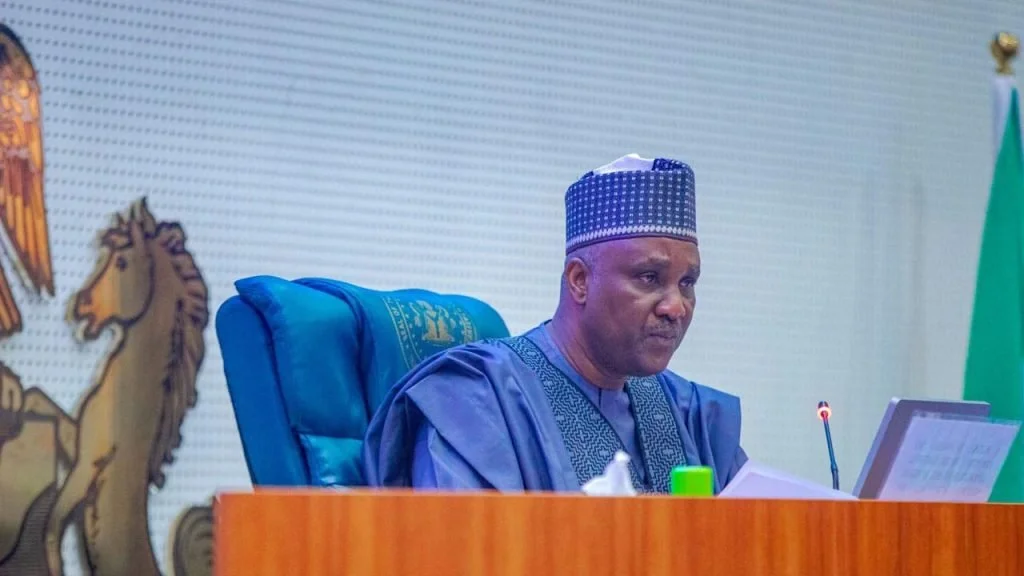
Speaker of the House of Representatives, Rt. Hon. Abbas Tajudeen, on Wednesday assured Nigerians that the proposed State Police would not become instruments of political intimidation, saying the Executive Bill before the National Assembly contains strong constitutional safeguards to prevent abuse by governors or political actors.
Speaking at the National Security Roundtable organised as part of the 2026 National Assembly Open Week at the National Assembly Library Trust Fund in Abuja, Abbas said concerns that state police could become “the private army of a governor or a political godfather” were legitimate but had been anticipated by the drafters of the constitutional amendment.

He explained that under the proposal, a state’s Commissioner of Police would be appointed on the recommendation of the National Police Council, confirmed by the State House of Assembly, and could only be removed by a two-thirds majority of the Assembly for good cause.
The Speaker added that the Constitution would also empower the Federal Police to intervene where a state police service becomes compromised, but only under clearly defined conditions, for a limited period, and subject to judicial oversight.
Abbas described the proposed legislation as one of the country’s most significant constitutional reforms, commending President Bola Tinubu for transmitting the Executive Bill to the National Assembly after decades of debate on state policing.
He argued that Nigeria’s centralised policing structure could no longer effectively tackle growing security threats, including banditry, kidnapping, farmer-herder clashes and attacks on schools, stressing that such challenges require locally driven policing backed by community knowledge and accountability.
The Speaker said the Bill would rename the Nigeria Police Force as the Federal Police Service while allowing states to establish their own police services after meeting national minimum standards to be set by the National Assembly.
According to him, the Federal Police would retain responsibility for terrorism, border security, federal crimes and the Federal Capital Territory, while state police would focus on maintaining law and order within their respective states.
He said each state police service would be supervised by an independent State Police Service Commission with direct funding, while the Bill prohibits officers from using force or making arrests for political, ethnic, religious or personal reasons.
Abbas, however, said lawmakers must still address critical issues, including funding for state police, intelligence sharing between federal and state forces, and the role of vigilantes and community guards before passing the legislation.
He proposed a phased implementation of state police, beginning with the enactment of a National Minimum Standards Act, gradual rollout on a state-by-state basis, and sustainable funding arrangements to ensure professionalism and accountability.
House Leader, Prof. Julius Ihonvbere, called for traditional rulers and community-based organisations to be integrated into Nigeria’s security architecture, arguing that grassroots institutions possess valuable local intelligence essential for tackling insecurity.
Former Chief of Defence Staff, Gen. Lucky Irabor (Rtd), advocated a comprehensive overhaul of Nigeria’s security framework, urging greater investment in intelligence, stronger institutional collaboration and responsible deployment of technology to combat emerging threats.
Kaduna State Governor, Uba Sani, also advocated intelligence-led policing, improved inter-agency collaboration and wider deployment of technology, including artificial intelligence, biometrics and forensic science, to strengthen national security.
The Etsu Nupe and Chairman of the Niger State Council of Traditional Rulers, Brig. Gen. Yahaya Abubakar (Rtd), endorsed the establishment of state police, describing it as a vital step towards improving grassroots security and community policing.
Other speakers, including Executive Secretary of the National Assembly Library Trust Fund, Henry Nwawuba, CoSPAL Secretary-General, Ambassador Dapo Oyewole, and the United Kingdom’s Head of Development Cooperation, Ms. Cynthia Rowe, called for evidence-based policymaking, stronger institutional collaboration and sustained stakeholder engagement to strengthen Nigeria’s security architecture.