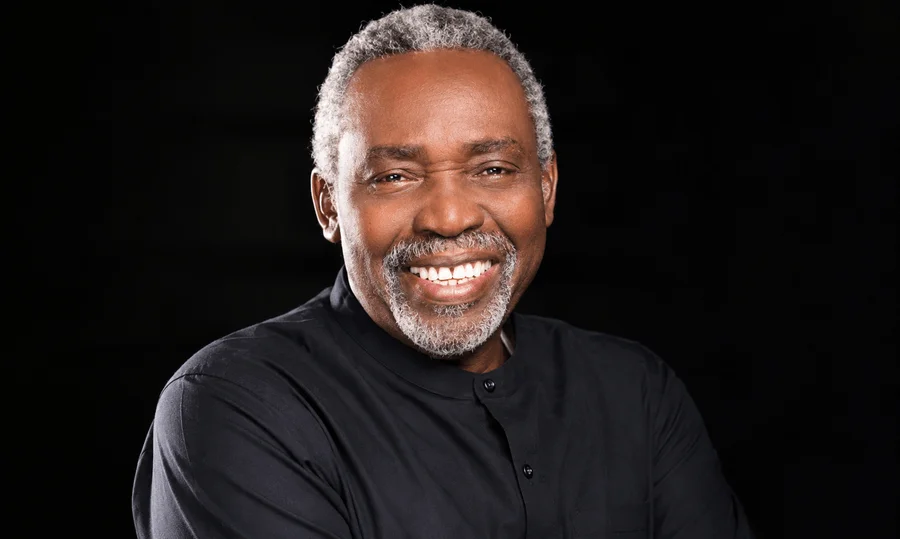
For a man who had been “killed” several times on social media, the final announcement carried an unmistakable authority. This time, it came from home.
Oludotun Baiyewu Jacobs, the actor generations of Nigerians knew simply as Olu Jacobs, died on Wednesday, September 16, 2026, at the age of 84.
His son, Olusoji Jacobs, announced the death on behalf of the family, describing his father by a name that captured both the man and the institution he built: “The Lion of Lufodo.” The family spoke of “a life well lived and fought” and appealed to bloggers and social-media influencers to respect its privacy.
After years of false reports about his death, Nigeria finally has to say goodbye.
But the country will not remember the rumours.
It will remember the voice.
The Voice That Announced Authority
There was something about the Olu Jacobs baritone that seemed made for authority.
Give him the role of a king, chief, general, senior lawyer, wealthy patriarch or troubled father and, before the scene had properly begun, the audience understood who commanded the room.
It was why he became one of the most recognizable father figures of the Nollywood era.
Yet Nollywood did not manufacture Olu Jacobs.
Long before Nigerian home video made him a household name, Jacobs had undergone the kind of professional preparation that would eventually distinguish him from generations of performers.
Born on July 11, 1942, to Egba Alake parents, he spent much of his childhood in Kano. There, encounters with the travelling theatre of legendary dramatist Hubert Ogunde helped ignite his interest in acting. He subsequently travelled to Britain and trained at the prestigious Royal Academy of Dramatic Art in London.
That decision changed everything.
Britain Knew Him Before Nollywood
Before Nigerian audiences embraced Jacobs as one of Nollywood’s patriarchs, British audiences had already seen him at work.
During the 1970s, he appeared in British television productions including The Goodies, Till Death Us Do Part, Barlow at Large, Angels, The Tomorrow People and The Professionals.
He also played President Mageeba in Tom Stoppard’s Night and Day and later appeared in international films including The Dogs of War, Roman Polanski’s Pirates and Baby: Secret of the Lost Legend.
By the time he became a dominant presence in Nigerian film and television, therefore, Jacobs was not learning how to command a camera.
He had already served his apprenticeship.
Wife Pens Emotional Message As Olu Jacobs Turns 83
Back home, appearances on television, including The Third Eye, and subsequently in more than 100 films turned him into one of the defining faces of Nigerian screen acting.
That international foundation partly explains why his performances seemed different. The pauses, diction and physical restraint came from a performer who understood that authority did not always need shouting.
Sometimes Olu Jacobs merely had to look across the room.
Then There Was Joke Silva
Any account of what Nigerians will remember about Jacobs would be incomplete without Joke Silva.
Their marriage became almost as celebrated as their individual careers.
They met through theatre in the early 1980s and eventually married despite an age difference of about 19 years. Silva has recalled that her father initially had reservations about the age gap, although her mother was supportive.
Perhaps one of the most revealing stories about Jacobs as a husband concerned his wife’s name.
At a time when a married woman retaining her maiden name could easily provoke cultural argument, Jacobs encouraged his wife to remain professionally Joke Silva.
He understood that she had already begun building a brand before marriage and believed changing the name could damage it.
Jacobs himself once explained the thinking simply: she was an individual who had already become known to audiences as Joke Silva, so marriage should not deny her that identity.
It was an unusually modern position for its time.
Together, the couple subsequently turned their marriage into something larger than two successful acting careers.
They built the Lufodo Group, encompassing production and other entertainment ventures, and the Lufodo Academy of Performing Arts, where another generation could receive the professional training they considered essential to the craft.
Long before “power couple” became an entertainment cliché, Olu Jacobs and Joke Silva demonstrated what the phrase could mean.
The Awards Eventually Caught Up
Recognition followed.
Jacobs won the Africa Movie Academy Award for Best Actor in a Leading Role in 2007 for Dancing Heart.
In 2011, President Goodluck Jonathan conferred on him the national honour of Member of the Order of the Federal Republic, MFR.
The Africa Magic Viewers’ Choice Awards honoured him with its Industry Merit Award in 2013, while AMAA presented him with a Lifetime Achievement Award in 2016. He also received lifetime recognition from the Africa International Film Festival.
But perhaps his greatest honour was simpler: several generations of Nigerian actors came to regard him as one of the profession’s elders.
Not merely because he was old, but because he had done the work.
When The Voice Became Quiet
The closing years were difficult.
In 2021, Joke Silva publicly disclosed that her husband was living with dementia with Lewy bodies, explaining the changes Nigerians had begun noticing in the once-commanding actor.
It was a particularly cruel illness for a performer whose memory, voice and physical presence had been among his greatest instruments.
Nostalgic Throwback: Rare Clip of Olu Jacobs In A 47-Year-Old Movie (Video)
His declining public appearances also encouraged repeated false reports of his death. His family had to deny such claims more than once.
Now the rumours have finally given way to reality.
What Nigeria Keeps
The awards will remain in the record books. The hundreds of performances will survive on screens. The photographs will preserve the familiar beard, imposing frame and unmistakable smile.
But Nigeria’s memory of Olu Jacobs will probably be simpler.
A boy growing up in Kano watched Hubert Ogunde and decided that acting could be a life’s work.
He crossed continents to learn that work properly.
Britain gave him a stage before Nigeria gave him Nollywood. And when the Nigerian film industry exploded, he returned with decades of craft behind him and helped give the young industry something it desperately needed: stature.
He built alongside Joke Silva rather than asking her to disappear behind his name. Together they created an academy so that their knowledge could travel beyond their own careers.
And then there was that voice.
For half a century, Olu Jacobs could walk into a scene and make power seem less like something written into a script than something accumulated over a lifetime.
Nigeria will remember the kings, chiefs, generals and fathers.
But behind all of them was the same actor—the Kano boy who saw Hubert Ogunde perform and decided, against convention, that play could indeed be work.
And what work it became.