An MJConcept TV News review of data published by the socio-accountability platform Govspend has shown that Nigeria’s Ministry of Arts and Culture and Creative Economy negated fiscal laws by paying over N23 million into the private accounts of one of its Directors.
A review of the data published by the platform shows that the monies were paid into the account of “Akudo-Nwosu Ugochi Nwakaego”.
According to the published details, on December 3, 2019, she was paid N8 million, with the description reading “Abuja Carnival Expenses.”
On the same day, another sum of N5.7 million was also paid for “Abuja Carnival Expenses”, which was again deposited into her private account. Both payments were made by the “Federal Ministry of Information and Culture Hqtrs.“
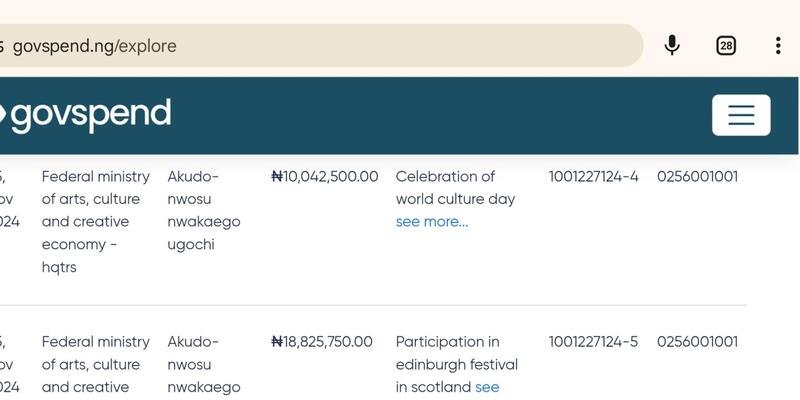
On November 25, 2024, a sum of N10.042 million was paid into her account for the “celebration of World Culture Day”.
The money was paid by the “Federal Ministry of Arts, Culture and Creative Economy“.
The total sum of N23.8 million was paid into her private account for institutional programmes.
Checks show that the beneficiary, Akudo Nwosu, is listed as the “Director of Entertainment and Creative Economy” at the Federal Ministry of Arts, Culture, Tourism and Creative Economy.
These payments contravene Chapter Seven, Section 713 of Nigeria’s Financial Regulations 2009, which states: “Personal money shall in no circumstances be paid into a Government bank account, nor shall any public money be paid into a private account.”
The section reads: “Any officer who pays public money into a private account is deemed to have done so with fraudulent intention.”
Aside from the above-listed amounts, on November 25, 2024, according to Govspend, she was paid N83.3 million for participating in different programmes across various countries.
A breakdown of the N83.3 million shows she was paid N18.8 million for participating in the “Edinburgh Festival in Scotland”.
Another sum of N11.4 million was paid to her for “Training administration and key staff of the department”.
A further N38.1 million was paid for “Canex Wknd 2024 in Algeria”, while N15 million was disbursed to her for participating in the “60th Art Exhibition at Venice, Italy”.
A lawyer, Kehinde Awosusi, while speaking to MJConcept TV News, noted that the law frowns on receiving government funds into personal accounts.
“Under no circumstances should a Civil Servant receive Government money into a personal account, either Government income or Government expenditures,” he said.
“You can look at the case of Betta Edu and the issues that arose from it and the clear violations she was accused of committing. It is a clear affront on the position of the law.”
Edu, formerly Nigeria’s Minister of Humanitarian Affairs and Poverty Alleviation, was suspended by President Bola Tinubu on January 8, 2024, following allegations of financial misconduct involving the unauthorized transfer of ₦585 million into a private account.
The controversy emerged when a memo, allegedly signed by Edu, directed the Accountant General of the Federation to transfer ₦585,198,500 to the personal account of Oniyelu Bridget, a project accountant, purportedly for grants to vulnerable groups in four states.
The Accountant General confirmed receiving the request but did not act on it. Edu defended the action, claiming it adhered to civil service procedures, but the incident sparked public outrage.
President Tinubu ordered an investigation into the financial transactions of her ministry, involving the Economic and Financial Crimes Commission (EFCC).
Later, in October 2024, Tinubu carried out a major cabinet reshuffle, dismissing five ministers and nominating seven new ones.
Although Edu’s name was not explicitly mentioned among the sacked ministers, the presidency confirmed that she would not be returning to the cabinet. The Special Adviser to the President on Information and Strategy, Bayo Onanuga, stated that Edu’s position had already been taken over by Dr. Nentawe Yilwatda, effectively confirming her removal.
The Presidency remained silent on the outcome of the EFCC investigation but implied that the findings justified her suspension.